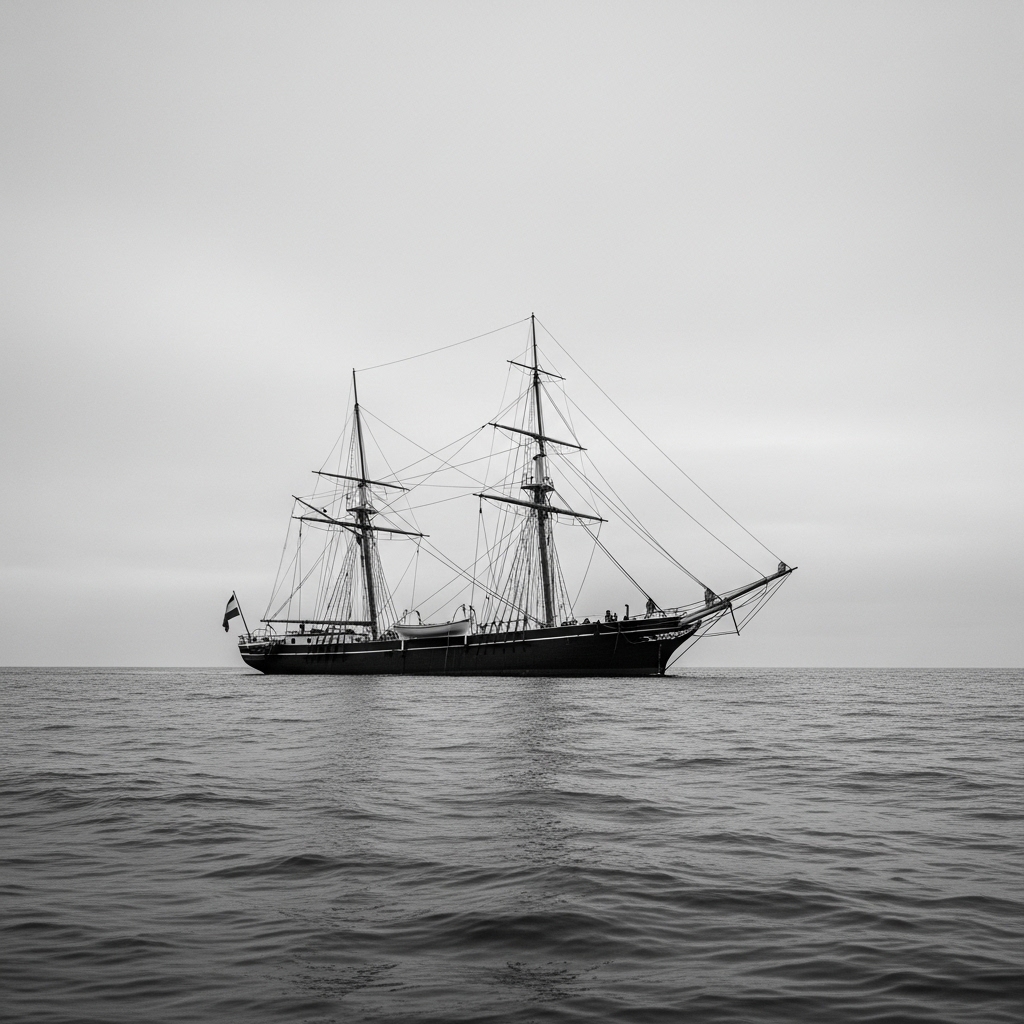
The ocean has a way of swallowing secrets, but on December 4, 1872, it spat one back out. When the crew of the Dei Gratia spotted a brigantine drifting aimlessly about 400 miles east of the Azores, they didn’t see a shipwreck. They saw a ship that looked, from a distance, like it was being guided by a ghost.
Captain David Morehouse, commanding the Dei Gratia, recognized the vessel immediately. It was the Mary Celeste. Only eight days earlier, he had shared a farewell dinner in New York with its captain, Benjamin Briggs. Briggs was a seasoned, teetotaling mariner—a man not given to panic or superstition. He had his wife, Sarah, and their two-year-old daughter, Sophia, on board for the voyage to Genoa, Italy.
The Boarding Party’s Discovery
When Morehouse’s boarding party climbed the wooden hull, the silence they encountered was deafening. They found a ship that was eerily “mid-sentence.” In the galley, the stove was still warm, and a meal appeared to have been recently prepared. The crew’s clothing was dry and tucked away in their chests. Even the ship’s chronometer and the captain’s sextant—tools no sailor would ever leave behind—were missing, yet the ship’s log sat on the cabin table.
The last entry was dated November 25, nearly ten days prior. It reported the ship’s position near Santa Maria Island in the Azores. Since then, the Mary Celeste had traveled nearly 400 miles on its own, guided only by the wind and the currents.
The Missing Piece of the Puzzle
The most disturbing detail wasn’t what was on the ship, but what was gone. The single lifeboat was missing. One of the iron railings had been removed to launch it, and a long, frayed rope trailed in the water behind the vessel.
For over a century, the vacuum left by the missing crew was filled with wild speculation. Early newspapers, fueled by a young Arthur Conan Doyle, suggested a bloody mutiny. Others whispered of a giant squid reaching up from the abyss or a “seaquake” that had terrified the crew. But the evidence didn’t fit. There was no blood, no signs of a struggle, and the cargo—1,701 barrels of industrial alcohol—was still lashed down in the hold.
The “Invisible Explosion” Theory
The key to the mystery likely lay within those barrels. Modern historians and scientists have reconstructed the conditions in the hold during that fateful November. Unlike the “safe” alcohol we drink, industrial alcohol is highly volatile. It’s believed that several of the white oak barrels had leaked, filling the cramped hold with invisible, flammable vapors.
Imagine Captain Briggs’ position: The Atlantic heat was rising. Suddenly, a rumbling sound—a “flash” or a minor explosion caused by the built-up fumes—erupted from below. To a man with his wife and toddler on board, it would have sounded like the ship was about to become a floating bomb.
In a moment of calculated (but ultimately fatal) caution, Briggs likely ordered everyone into the small lifeboat. He didn’t intend to abandon the Mary Celeste forever. He likely tied the lifeboat to the main ship with a sturdy “peak halyard” rope, intending to tow behind at a safe distance until the fumes cleared.
The Moment the Rope Snapped
Then, the tragedy of timing struck. A sudden Atlantic squall or a shift in the wind likely filled the Mary Celeste’s sails. The heavy ship surged forward, putting immense tension on the rope connecting it to the small, overburdened lifeboat.
The rope snapped.
In a matter of seconds, the ten souls in the lifeboat watched as their only sanctuary—the massive, sturdy Mary Celeste—sailed away into the mist, unreachable. They were left in a tiny open boat with no navigational tools, no supplies, and no hope. They were never seen again.
When the Mary Celeste was brought into Gibraltar by the salvagers of the Dei Gratia, she was treated with suspicion and dread. She eventually became known as a “cursed” ship, changing hands seventeen times and suffering several more accidents before being intentionally wrecked off the coast of Haiti years later. But for those who study the sea, she remains the ultimate reminder: in the middle of the ocean, a single moment of panic can rewrite history forever.