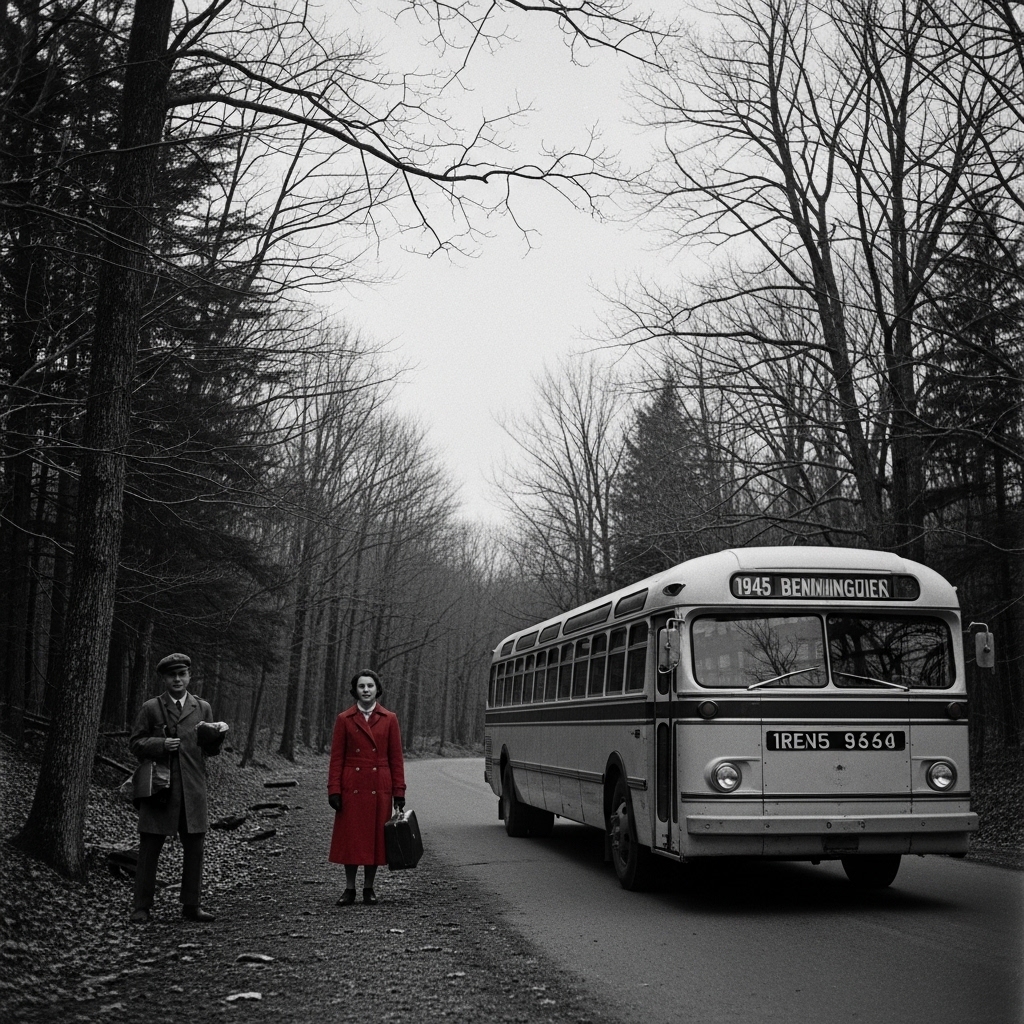
The Green Mountains of Vermont are known for two things: their breathtaking autumnal colors and a silence that, in certain places, feels heavy—almost intentional. In the southwestern corner of the state, nestled around the shadow of Glastenbury Mountain, lies a patch of wilderness that locals have whispered about for centuries. Long before the 1940s, the Native American tribes of the region warned that the mountain was “cursed ground,” a place where the winds changed direction without reason and where the earth itself seemed to swallow those who stepped off the path.
Between 1945 and 1950, those ancient warnings stopped sounding like folklore and started looking like a police blotter. During those five years, a series of disappearances occurred that defied logic, exhausted search parties of hundreds, and left the FBI scratching their heads. This is the story of the Bennington Triangle—a place where people didn’t just die; they evaporated.
The First Ripple: Middie Rivers
It began on a crisp November day in 1945. Middie Rivers was 74 years old, but he wasn’t a frail man. He was a seasoned mountain guide, a woodsman who knew the trails around Glastenbury like the back of his hand. He was leading a group of four hunters near the area known as “Hell Hollow.”
As the group was heading back toward their camp, Middie walked slightly ahead. He was less than a hundred yards in front of the others. One moment, his red hunting cap was visible through the leafless trees; the next, he stepped behind a bend. When the hunters reached that same bend seconds later, the trail was empty.
They called his name. Nothing. They searched for hours, then days. Eventually, the U.S. Army and local volunteers combed every square inch of the area. They expected to find a man who had tripped, suffered a heart attack, or perhaps been attacked by a bear. But they found nothing. No footprints in the soft mud, no torn clothing, no blood. The only thing they ever recovered was a single rifle shell in a stream—a shell Middie’s companions believed had fallen from his pocket. Middie Rivers, a man who had survived decades in the wilderness, had been erased by it.
The Impossible Disappearance: James Tedford
If Middie Rivers’ disappearance was a tragedy of the woods, the case of James Tedford was a defiance of physics. In December 1949, exactly four years after Middie vanished, Tedford—a veteran—was traveling by bus from St. Albans to Bennington.
There were fourteen other passengers on that bus. They all testified to the same thing: James Tedford was in his seat, sleeping, as the bus rumbled through the snowy Vermont landscape. He was seen at the last stop before Bennington. Yet, when the bus pulled into the terminal in Bennington, Tedford’s seat was empty.
His luggage was still in the overhead rack. His bus timetable lay open on the seat he had occupied just minutes before. The bus had not stopped between the last checkpoint and the station. The doors were closed. The windows were shut against the winter chill. To this day, there is no rational explanation for how a grown man could vanish from a moving vehicle surrounded by witnesses, leaving only his suitcase behind as a ghost of his presence.
The Girl in the Red Coat: Paula Welden
Perhaps the most famous case—and the one that led to the creation of the Vermont State Police—was that of Paula Welden. On December 1, 1946, the 18-year-old Bennington College student told her roommate she was going for a walk on the “Long Trail.”
She was dressed in a bright red parka, a color that should have stood out like a flare against the gray-and-white landscape. Several people saw her on the trail. An elderly couple spoke to her briefly. She was seen turning a corner on the path, heading toward the mountain.
When she didn’t return, a search of unprecedented scale began. The governor offered a reward. Even the FBI was called in. They searched the woods, the lakes, and the caves. They interviewed every resident for miles. But like Middie Rivers before her, Paula Welden seemed to have stepped into another dimension. No body was ever found. No red fibers from her coat were caught on the brambles. She simply ceased to exist.
The Boy in the Red Jacket: Paul Jephson
If the disappearance of grown men and college students wasn’t enough to paralyze the town of Bennington with fear, the events of October 12, 1950, certainly were. Eight-year-old Paul Jephson was riding in a truck with his father, a caretaker for a local dump. It was a mundane afternoon, a chore like any other.
His father stopped the truck to tend to the family’s pigs, leaving little Paul in the cab for what was supposed to be no more than a few minutes. The boy was wearing a bright red jacket—much like Paula Welden’s parka—making him easily visible against the autumn foliage. When the father returned to the truck, the door was shut, but the seat was empty. Paul was gone.
The reaction was immediate and massive. This wasn’t just another hiker; this was a child taken from his father’s side. Hundreds of volunteers, law enforcement officers, and even bloodhounds descended on the area. The dogs picked up Paul’s scent and followed it toward a nearby mountain trail. But then, something happened that chilled the searchers to the bone: at a specific point on the trail, the dogs simply stopped. They didn’t lose the trail; they began to act as if the scent had vanished upward into the air. They whined, circled, and refused to go further. Despite weeks of searching, not a single scrap of red fabric from Paul’s jacket was ever recovered.
The Return of Frieda Langer: A Grisly Exception
Just sixteen days after Paul Jephson vanished, the Bennington Triangle claimed its final—and most baffling—victim. Frieda Langer, a 53-year-old experienced hiker and mother, was trekking near the Somerset Reservoir with her cousin, Herbert Elsner.
Frieda slipped and fell into a stream, soaking her clothes. She told Herbert to wait while she ran back to their camp, just a few hundred yards away, to change into dry clothes. She was a fit, capable woman who knew these woods intimately. Herbert watched her jog toward the camp. He waited. And waited.
When he finally went to the camp to check on her, she wasn’t there. She hadn’t even arrived.
What makes Frieda’s case different—and far more disturbing—is what happened seven months later. On May 12, 1951, her body was found in an area that had been searched meticulously dozens of times during the initial investigation. The location was open, visible, and had been combed by line-searches of volunteers. Yet, there she was, as if she had been dropped back onto the earth.
Because of the state of decomposition, the medical examiner could not determine a cause of death. But the mystery remained: Where had she been for seven months? And why was her body found in a place where hundreds of people had already looked?
The “Bennington Monster” and the Ancient Curse
When logic fails, the human mind retreats into the supernatural. The local Abenaki tribes have avoided Glastenbury Mountain for centuries. Their oral traditions speak of a “stone that swallows people”—a literal spot on the mountain where, if you step on it, the earth opens up and pulls you into a void. They believed the mountain was a crossroads between worlds, a place where the barrier between our reality and something else was dangerously thin.
In the 19th century, before the disappearances of the 1940s, locals reported sightings of the “Bennington Monster”—a creature described as over seven feet tall, covered in hair, and possessing eyes that glowed like embers. Some believe a reclusive, feral man or a “Bigfoot”-like entity was responsible for the disappearances, stalking the hunters and hikers from the shadows of the pines.
The Scientific “Void”
Others look for answers in the earth itself. There are theories of “magnetic anomalies” in the Bennington Triangle that interfere with compasses and human orientation. Could these hikers have become so disoriented by shifting magnetic fields that they walked deeper into the wilderness until they succumbed to the elements in hidden caves?
But even science struggles to explain James Tedford’s disappearance from a moving bus. Some researchers suggest “localized wormholes” or “time slips”—pockets of space-time that open and close without warning, catching whoever happens to be walking by at the wrong second.
The Silence of Glastenbury
After 1950, the disappearances abruptly stopped. The “Triangle” fell silent. Today, the town of Glastenbury is a ghost town; the mountain has reclaimed the logging camps and the homes of the settlers. The Long Trail still winds through the Green Mountains, and hikers still visit the area, lured by the beauty of the Vermont wilderness.
But many who hike those trails report an overwhelming sense of being watched. They speak of “dead zones” where no birds sing and the wind seems to hold its breath. Whether the Bennington Triangle was the hunting ground of a serial killer who knew the woods better than the police, or a literal tear in the fabric of our world, one thing remains certain:
The Green Mountains don’t just keep secrets. They bury them.